From Scratch: Linear Regression
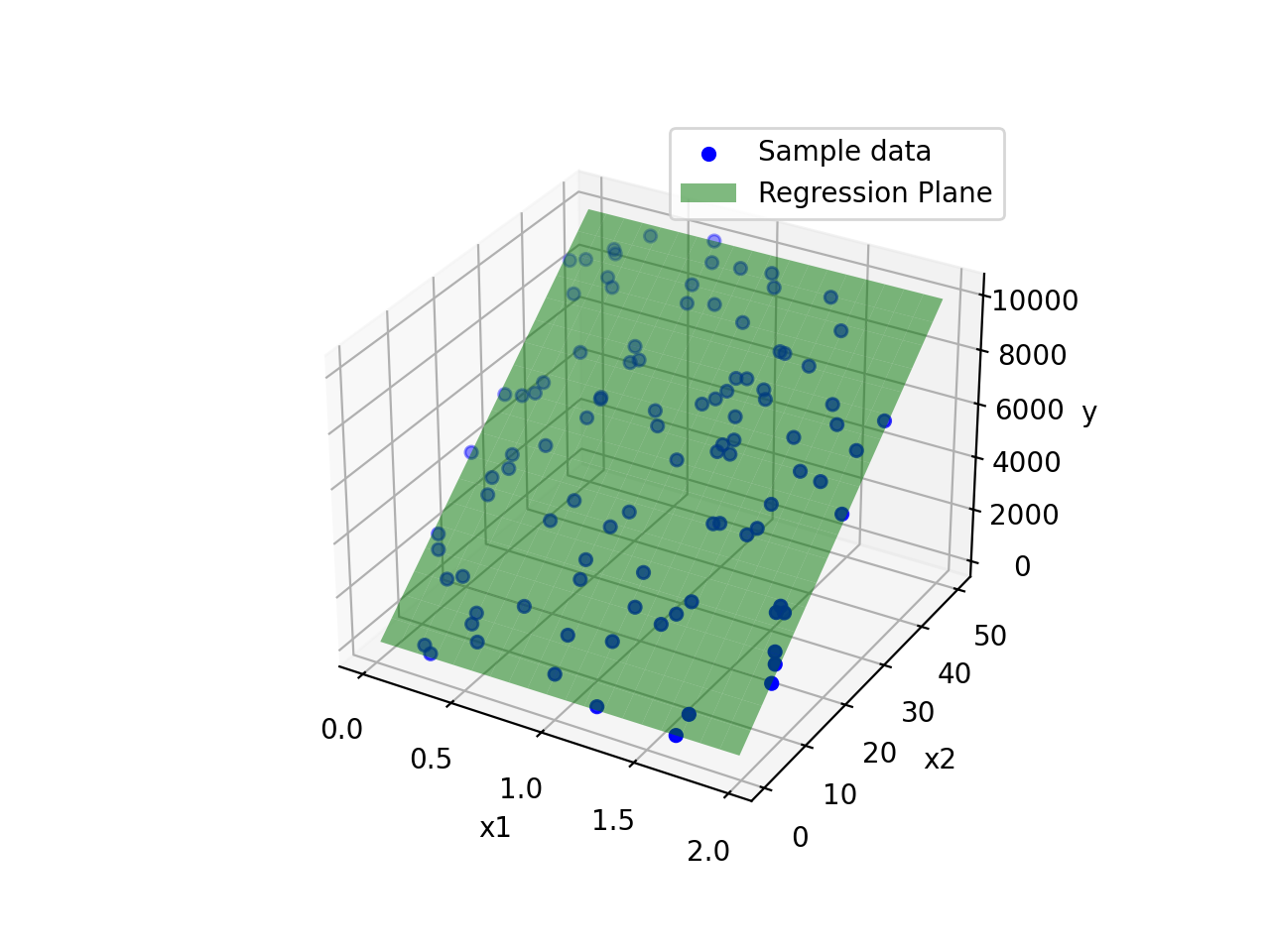
I implemented linear regression (gradient descent) using only numpy and matplotlib (for visualization). I made two implementation: a 1-feature version (the simplest case), and a generalized version (used 2-features for visualization). Here I’ll describe the general implementation.
Technical Details
Sample data. For easier validation, I generated noisy data based a predetermined target plane (). Here, the original feature matrix is defined as .
Feature scaling and adding bias. To speed up the convergence, all feature columns were normalized to z-scores
After that, a bias column is added:
Regression setup. Given the normalized feature matrix ( data points) with bias column and matrix of regression coefficients ( represents the bias), the regression in matrix notation is denoted as below. In numpy, all of these are np.array.
Loss function. The prediction error was measured through a 1/2-scaled mean square:
Gradient descent (regression). For each parameter , the update through gradient descent (with learning rate ) is defined as:
This is implemented in matrix form as:
Results. With , after 1000 iterations of gradient descent, the final parameters achieved were: